Pasture-Fed Basics: What makes Pasture-Based Raw Milk Exceptional?
(not all raw milk is created equal!)
IT IS NUTRITIONALLY DENSE: "[A] cow
raised on pasture produces far less milk than a cow raised
in a confinement dairy on a grain-based diet. This is a bane
for the farmer but a blessing for the consumer. The less milk
a cow produces, the more vitamins in her milk. This is because
a cow has a set amount of vitamins to transfer to her milk,
and if she's bred, fed, and injected to be a Super Producer,
her milk has fewer vitamins per glass. It's a watered down
version of the real thing."
IT IS HIGH IN OMEGA 3s and CLA: "CLA,
or "conjugated linoleic acid," is a type of fat
that may prove to be one of our most potent cancer fighters.
Milk from a pastured cow has up to five times more CLA than
milk from a grain-fed cow." "There are two families
of EFAs—omega-6 and omega-3 fatty acids. Studies suggest
that if you [consume enough omega 3 fatty acics], you will
have a lower risk of cancer, cardiovascular disease, autoimmune
disorders, allergies, obesity, diabetes, dementia, and various
other mental disorders.[2]"
IT IS A TRULY NATURAL, NEARLY PERFECT FOOD:
Raw, pasture-based milk is a natrual phenomena because through
the magnificent cow, a non-human food source (grass) is transformed
into one of nature's super foods. What besides milk can sustain
the babies of all mammal species as a sole food source, and
contains the perfect balance of proteins, carbohydrates, and
healthy fats? Raw milk also contains a host of vitamins and
minerals along with the enzymes needed to assimilate these
vital nutrients.
(quotes above are excerpts from the full article below)
What is Pure Food Co-op LLC?
We are a co-op that consists of small-scale local food producers
that produce wholesome, healthy, local food and are supported
by like-minded comsumer members that care about where their
food comes from and how it is produced. When you join our
co-op, you are supporting a food system that doesn't rely
on grocery stores or anything close to factory farming; you
are supporting families who take the time to produce food
in a better way. Pure Food Co-op producers make real
food available. We believe in high quality, nutritionally
dense food, grown locally through natural and humane treatment
of animals and sustainable food production practices. Our
animals eat grass and live in the great outdoors, never in
confinement where dangerous bacteria are bred and food quality
is compromised; we are proud that all our dairy, eggs,
and meat products are pasture-based. Our cattle roam
pastures, feed on fresh grass or grass hay in winter, our
chickens have room to roam and scratch. The food these animals
produce is nutritionally superior and satisfying.
We offer products for pickup or delivery, to make your access
to this food easy and worthwhile. Our goal is to keep prices
reasonable for both consumers and producers and make this
wonderful food available in this area from small, sustainable
operations like ours! If you want to purchase products from
or produce food for Pure Food Co-op, simply apply
for a membership.
| SUPER
NATURAL MILK
By Jo Robinson
(article courtesy of eatwild.com)
Most cartons of milk in the supermarket show a picture
of cows contentedly grazing on grass. In reality, 85
to 95 percent of the cows in the United States are now
being raised in confinement, not on pasture. ...
The reason for confining cows in feedlots and feeding
them grain rather than grass is that they produce far
more milk under these unnatural conditions. If you also
inject them with bi-weekly hormones, standard practice
in the dairy industry, they produce even more. Milk
them three times a day instead of two and you have the
tried and true formula for today’s Super Producers.
On average, cows raised in confinement produce more
than three times as much milk as the family cow of days
gone by and 15 times the amount required to raise a
healthy calf.
But with so much emphasis on quantity, the nutritional
content of our milk has suffered. One of the biggest
losses has been in its CLA content. CLA, or "conjugated
linoleic acid," is a type of fat that may prove
to be one of our most potent cancer fighters. Milk from
a pastured cow has up to five times more CLA than milk
from a grain-fed cow. To date, most of the proof of
the health benefits of CLA has come from test tube or
animal studies. But a few human studies have produced
encouraging results. For example, French researchers
compared CLA levels in the breast tissues of 360 women.
The women with the most CLA in their tissue (and thus
the most CLA in their diets) had a 74 percent lower
risk of breast cancer than the women with the least
CLA [1]. If an American woman were to switch from grain-fed
to grass-fed dairy products, she would have CLA levels
similar to the women in the study who had the lowest
rate of cancer.
Milk from pastured cows also contains an ideal ratio
of essential fatty acids or EFAs. There are two families
of EFAs—omega-6 and omega-3 fatty acids. Studies
suggest that if your diet contains roughly equal amounts
of these two fats, you will have a lower risk of cancer,
cardiovascular disease, autoimmune disorders, allergies,
obesity, diabetes, dementia, and various other mental
disorders.[2]
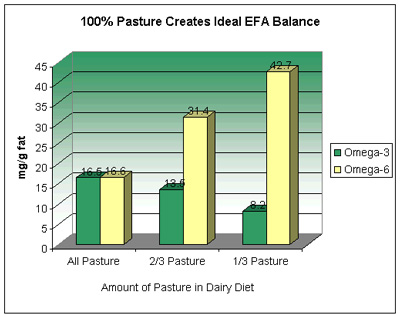
Take a few moments to study the chart below showing
EFA levels in milk from cows fed varying amounts of
grass and grain.[3] The green bars represent omega-3
fatty acids, and the yellow bars represent omega-6 fatty
acids. As you can see, when a cow is raised on pasture
(represented by the two bars on the far left), her milk
has an ideal, one-to-one ratio of EFAs.
Take away one-third of the grass and replace it with
grain or other supplements (represented by the two bars
in the middle) and the omega-3 content of the milk goes
down while the omega-6 content goes up, upsetting an
essential balance.
Replace two-thirds of the pasture with a grain-based
diet (illustrated by the two bars on the far right)
and the milk has a very top-heavy ratio of omega-6 to
omega-3 fatty acids. This ratio has been linked with
an increased risk of a wide variety of conditions, including
obesity, diabetes, depression, and cancer. Much of the
milk you buy in the supermarket has an even more lopsided
ratio than this because the cows never graze on pasture.
Milk from pastured cows offers additional health benefits.
(I'm beginning to sound like a TV infomercial: "But
wait! There's more!") Besides giving you five times
more CLA and an ideal balance of EFAs, grass-fed milk
is higher in beta-carotene, vitamin A, and vitamin E.
This vitamin bonus comes, in part, from the fact that
fresh pasture has more of these nutrients than grain
or hay. (When grass is dried and turned into hay, it
loses a significant amount of its vitamin content.)
These extra helpings of vitamins are then transferred
to the cow's milk." ...
Jo Robinson is a New York Times bestselling writer.
She is the author or coauthor of 11 nationally published
books including Pasture Perfect, a comprehensive overview
of the benefits of choosing products from pasture-raised
animals, and The Omega Diet (with Dr. Artemis Simopoulos)
the healthiest diet of all Mediterranean diets . To
order Jo’s books or learn more about grass-fed
products, visit http://eatwild.com. |
|
What our
members are saying about our products and services:
| "You guys are awesome! Did I tell you my daughter
had a cavity heal since I got her back on raw milk?
Yay!!! I feel so lucky to be a part of your co-op."
- Amy, Boise |
| "The quality of your products is so much better
than anything else out there. I can't imagine not having
your cream for my fruit and butter to add to my meals,
let alone the cheese (especially the cream cheese).
"Thank you for all that you do for all of us.
You work so hard at bringing us the very best products.
I am especially excited about the grass fed beef."
- Susan, Boise |
|
"I am grateful for your excellent customer service...
You have been most understanding and willing to go out
of your way... I want very much to support what you
are doing and to see you succeed and your business thrive.
You are making this world a healthier place and I am
glad to be a part of that in some little way."
- Laurie, Boise |
|
"We love your raw milk. My daughter wouldn't order
milk at a restaurant the other day because it was normal
milk."
- Lorna, Meridian
|
| "When I got my recent blood test my bad cholesterol
was down and my good cholesterol up. The doctor was
surprised and told me to keep doing whatever it is I'm
doing. The only thing I can think of that has been different
is your great products!"
" My granddaughter loves the milk and I do also.
I love the butter and the cream cheese!"
"Thanks so much for all your products... Keep
up the good work!!"
- Connie, Meridian
|
| "I love your raw milk, and so does my lactose-intolerant
sister! She can drink as much as she wants with no problem,
unlike the pasteurized products! Also unlike the pasteurized
products, the raw milk doesn't leave your mouth feeling
sticky or phlegmy! I'll never go back!
" I was starting to notice that I was getting stomach
aches after eating regular yogurt, and the raw milk
yogurt doesn't bother my stomach at all!"
"I know that eggs in the store have often traveled
over a long distance, and sat on the shelf for a long
time. I also know that many large farms cheat the requirements
to be "free-range". So I am so glad to find
a local, fresh, and trustworthy source for my eggs (and
dairy)!"
-Tracey, Boise |
| "The yogurt was awesome for breakfast this
morning!"
- Pam, Boise |
| "We really love the round glass jars... the milk
in the jars smells like it was just poured from the
milking pail! And so much easier to skim a little cream.
You are providing a wonderful much-needed service and
we are very grateful."
- Kim, Boise |
| "Thanks for everything, the cheeses are DELISH!!!
The eggs are great! I really appreciate all that you
do."
- Christina, Nampa
|
| " I am glad that you are continuing to expand
your capabilities and products you offer!"
- Brad, Meridian |
|
" I have tried other grass-fed beef but was
not wild about the processing--seems there was always
a lot of gristle and/or bone chips. But this was so
much better. Plus the flavor was great."
- Margaret, Meridian |
|
"Thanks so much for the wonderful dairy products!
The cream and yogurt are amazing! Not sure if it's the
anti-bodies or what, but I'm the only one at work who
isn't sick."
- Lauren, Boise |
| "I love your products. Thanks so much."
- Rosetta, Boise |
|
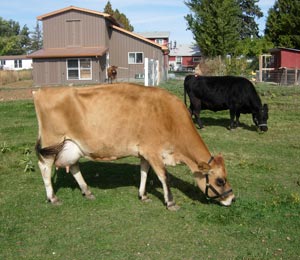
Picture: Our cows turning the green grass into
healthy, raw milk! To read more about our producers,
visit our Producers page.
What's the big deal with
Raw Milk?
There is a lot of controversy regarding the benefits of raw
milk, as well as the safety of drinking it. You can visit
our Raw Milk Information Page for some
resources to learn more. Many federal organizations openly
warn against consuming the product and claim that there are
neglible nutritional differences. Unfortantely, comparing
the "nutritional label" of raw vs. pasteurized milk
doesn't adequately compare the two products, because regardless
of whether fortified, pasteurized milk and raw unprocessed
milk contain the same amount of calcium, for example, there
are many more considerations. We all know that "cooking"
any food dramtically changes that food. Here is a short list
of some components of milk changed by the process of pasteurization:*
NUTRIENT DEGRADATION BY PASTEURIZATION:
Vitamin C: Raw milk but not pasteurized
can resolve scurvy. “. . . Without doubt. . . the explosive
increase in infantile scurvy during the latter part of the
19th century coincided with the advent of use of heated milks.
. .” (Rajakumar, Pediatrics. 2001;108(4):E76).
Calcium: Longer and denser bones on raw
milk (Studies from Randleigh Farms).
Folate: Carrier protein inactivated during
pasteurization. (Gregory. J. Nutr. 1982, 1329-1338).
Vitamin B12: Binding protein inactivated
by pasteurization.
Vitamin B6: Animal studies indicate B6 poorly
absorbed from pasteurized milk (Studies from Randleigh Farms).
Vitamin A: Beta-lactoglobulin, a heat-sensitive
protein in milk, increases intestinal absorption of vitamin
A. Heat degrades vitamin A. Said and others (Am J Clin Nutr.
1989;49:690-694. Runge and Heger. J Agric Food Chem. 2000
Jan;48(1):47-55).
Vitamin D: Present in milk in protein-bound
form, assimilation possibly affected by pasteurization. Hollis
and others ( J Nutr. 1981;111:1240-1248).
Iron: Lactoferrin, which contributes to
iron assimilation, destroyed during pasteurization.
Iodine: Lower in pasteurized milk. Wheeler
and others (J Dairy Sci. 1983;66(2):187-95).
Minerals: Lactobacilli, destroyed by pasteurization,
enhance mineral absorption (MacDonald and others. 1985).
Health Benefits of Raw Milk:
ASTHMA: Three recent studies in Europe found
that drinking “farm” (raw) milk protected against
asthma and allergies (Lancet. 2001 Oct 6;358(9288):1129-33;
J Allergy Clin Immunol. 2006 Jun;117(6):1374-8; Clinical &
Experimental Allergy. 2007 May; 35(5) 627-630).
RAW HUMAN MILK: In recent studies, infants
on pasteurized human milk did not gain weight as quickly compared
to those fed raw human milk (J Pediatr Gastroenterol Nutr.
1986 Mar-Apr;5(2):248-53) and premature babies given raw human
milk had more rapid weight gain than those given pasteurized
human milk. Problems were attributed to pasteurization's destruction
of lipase (J Pediatr Gastroenterol Nutr. 1986 Mar-Apr;5(2):242-7).
THE MILK CURE: In the early 1900s, the Mayo
Clinic administered the “Milk Cure,” which consisted
in drinking 4-5 quarts of raw milk per day, obtaining favorable
results for a range of illnesses including cancer, weight
loss, kidney disease, allergies, skin problems, urinary tract
problems, prostate problems and chronic fatigue; these results
are not obtained using pasteurized milk.
DANGERS OF PASTEURIZED MILK: Many studies
have linked consumption of pasteurized milk with lactose intolerance,
allergies, asthma, frequent ear infections, gastro-Intestinal
problems, diabetes, auto-Immune disease, attention deficit
disorder and constipation. During a period of rapid population
growth, the market for fluid pasteurized milk has declined
at 1% per year for the past 20 years. Fewer and fewer consumers
can tolerate pasteurized (and ultrapasteurized) milk (Don’t
Drink Your Milk, Frank Oski, MD, 1983).
LACTOSE INTOLERANCE: In a survey of raw
milk drinkers in the state of Michigan, over 80 percent of
those advised by a healthcare professional that they were
lactose intolerant were able to consume raw milk without problem.
(LactoseIntoleranceSurvey.doc).
POSITIVE TESTIMONIALS: Hundreds of testimonials
involving reversal of failure to thrive in infants; allergies,
asthma and behavior problems in children; and digestive disorders,
arthritis, osteoporosis and even cancer in adults (Testimonials,
MI-RawMilkHealthTestimonials.pdf).
PROTECTIVE COMPONENTS:
Raw milk contains numerous components that assist in:
* Killing pathogens in the milk (lactoperoxidase, lactoferrin,
leukocytes, macrophages, neutrophils, antibodies, medium chain
fatty acids, lysozyme, B12 binding protein, bifidus factor,
beneficial bacteria);
* Preventing pathogen absorption across the intestinal wall
(polysaccharides, oligosaccharides, mucins, fibronectin, glycomacropeptides,
bifidus factor, beneficial bacteria);
* Strengthening the Immune System (lymphocytes, immunoglobulins,
antibodies, hormones and growth factors) (Scientific American,
December 1995; British J of Nutrition, 2000:84(Suppl. 1):S3-S10,
S75-S80, S81-S89).
USDA/FDA STATISTICS: Based on data in a 2003 USDA/FDA report:
Compared to raw milk there are 515 times more illnesses from
L-mono due to deli meats and 29 times more illness from L-mono
due to pasteurized milk. On a PER-SERVING BASIS, deli meats
were TEN times more likely than raw milk to cause illness
(Intrepretive Summary – Listeria Monocytogenes Risk
Assessment, Center for Food Safety and Applied Nutrition,
Sept. 2003, page 17).
OUTBREAKS DUE TO PASTEURIZED MILK: Due to high-volume distribution
and its comparative lack of anti-microbial components, pasteurized
milk when contaminated has caused numerous widespread and
serious outbreaks of illness, including a 1984-5 outbreak
afflicting almost 200,000 people. In 2007, three people died
in Massachusetts from illness caused by contaminated pasteurized
milk (Real Milk PowerPoint, slide 30).
READ
MORE from the Weston
A. Price Foundation
|